95% of enterprise AI returns nothing. What the 5% get right.
A version of this first went out on my LinkedIn. This is the longer thought behind it.
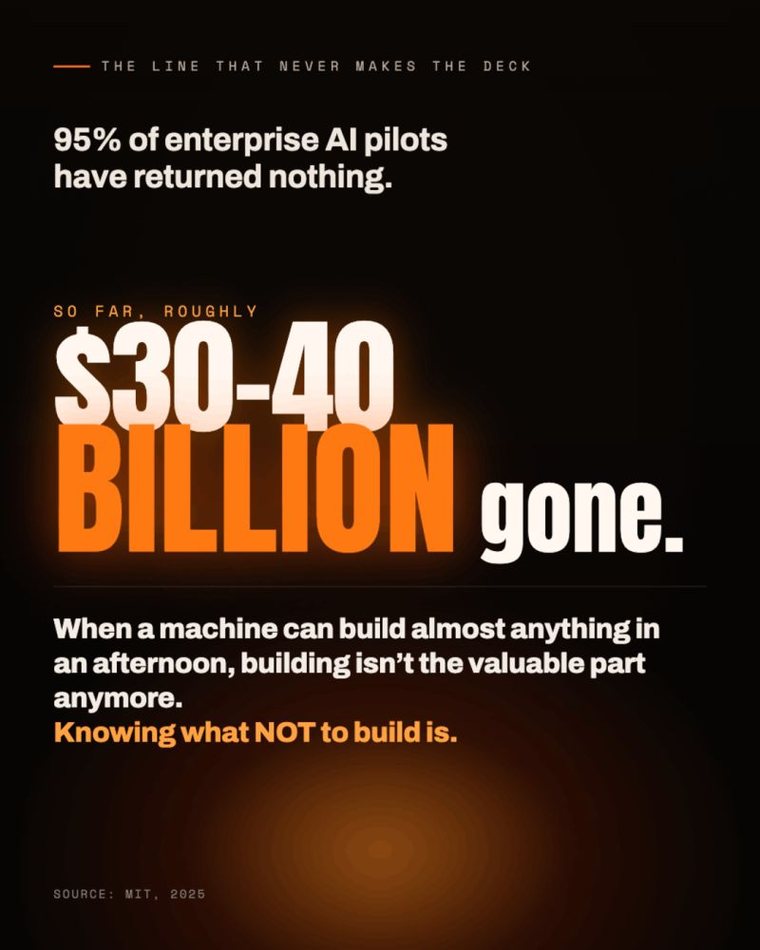
MIT's NANDA initiative studied the state of AI in business in 2025 and found something most vendors would rather you did not hear. Around 95% of enterprise AI pilots returned no measurable impact on the business. Only about one in twenty moved a real number. Companies have spent enormous sums, and most of it has quietly returned nothing.
It is tempting to read that as a story about the technology falling short. It is not. The models work. You can sit down today and have a machine draft, summarize, classify, and build in an afternoon what used to take a team a week. The failure is not that the tech cannot do the thing. The failure is that most companies built the wrong thing, and built it well.
Why the pilots die
When you look at where these projects fall apart, the pattern is consistent, and it is rarely technical. A pilot gets funded because AI is on the board's agenda, not because someone traced a specific, expensive problem to a specific workflow. The tool gets built, it demos beautifully, and then it meets the messy reality of how people actually work, and it has no answer for it. The same MIT work found that the tools which stall are the ones that do not learn or adapt to the workflow they are dropped into. They are clever in the demo and useless on the third Tuesday.
There is a money version of the same mistake. A lot of AI budget goes to the visible, exciting places, the sales and marketing use cases, while the return tends to sit in the unglamorous back office, in the processes nobody wants to present on a slide. So spend goes one way and value sits the other way, and a year later the pilot is quietly shelved with a note that says AI did not work for us. AI worked fine. The aim was off.
The skill that got scarce
Here is the shift almost nobody has priced in yet. When building was hard and slow, deciding what to build barely mattered, because you could only afford a few swings anyway. Now that a machine can build almost anything in an afternoon, building is no longer the valuable part. The scarce skill is judgment about what not to build.
That sounds like a small distinction. It is the whole game. The 5% who get a return are not the ones with the best models. They are the ones who pointed a good-enough model at a problem that was actually worth solving, in the one workflow where the math compounds, and who had the discipline to ignore ten shinier ideas to do it. The 95% did the opposite. They built the impressive thing instead of the useful one.
What the 5% actually do
The MIT findings line up with what I have watched work in practice. Two things separate the projects that survive.
The first is that they buy expertise instead of learning it the hard way on their own dime. In the study, teams that brought in specialized partners succeeded far more often than teams that tried to build it all internally, by a wide margin. That is not a knock on internal teams. It is that a partner who has already shipped this kind of system a dozen times knows where the bodies are buried, and a first-timer pays to find each one. The second is that the survivors aim at a real operational problem and build for the day the thing has to run for real, not for the day it has to pass a demo.
That is exactly how my teams at ScalaCode approach it, and it is why I will talk a client out of an AI project as readily as into one. If the honest answer is that a workflow does not have a problem worth the spend, or that a simpler piece of software solves it without the model, we say so. We would rather lose that piece of work than hand someone a pilot that joins the 95%. The reputation of the whole practice depends on the AI we ship actually earning its keep, which is why the number I care about is not how much we build, but how much of it is still running and paying off a year later.
Before you fund the next one
If you are about to start an AI project, here is the question I would sit with before writing the cheque. Not "can AI do this," because the answer is almost always yes and that is exactly the trap. Ask instead: what specific, expensive problem does this solve, in which exact workflow, and how will we know in ninety days whether it moved a number we already care about. If you cannot answer that cleanly, you do not have an AI project yet. You have a demo waiting to disappoint you.
When a machine can build almost anything, the winners are not the ones who build the most. They are the ones who know what not to build.
Figuring out what is worth building, and building it to actually hold up, is what my teams do. See how ScalaCode works, or get in touch.
Source: The GenAI Divide, State of AI in Business 2025, MIT NANDA initiative.